Digital Twin

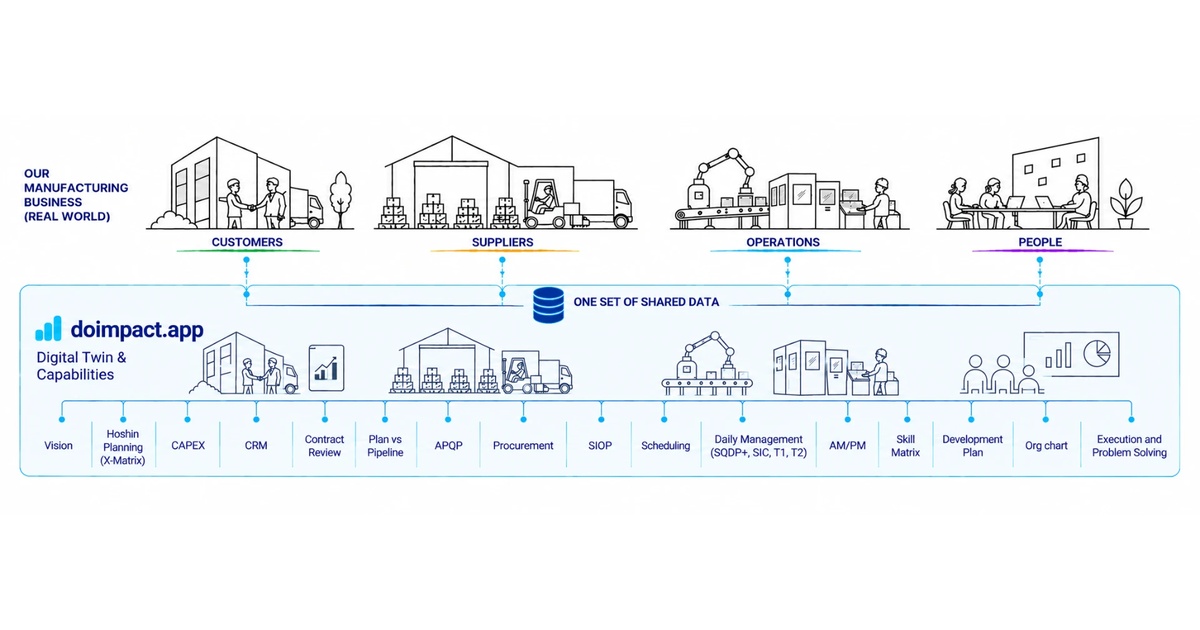
A live digital twin of your entire manufacturing operation

Every manufacturer has machines. Very few have a model. DO.Impact holds strategy, commercial, operations, people and execution in one connected model of the business, updated by the daily work — so the front line and the board room look at the same truth.

In short

A digital twin of a manufacturing business is a live model of how the company actually runs: objectives, value streams, orders, machines, skills, suppliers and cash, connected and kept current by daily work. Unlike a dashboard, which reports what already happened, the twin links cause and effect so a decision can be tested and its result followed.

Illustration of a factory floor mirrored by a live digital model connecting strategy, commercial, operations, people and execution
  • No email
  • No credit card
  • No sales call

Prefer your own numbers? Start the free 7-day sandbox.

Most plants have a digital shadow, not a twin

ERP holds the transactions, MES holds the machine data, spreadsheets hold the plan and dashboards summarize last month. Each looks backwards on its own. That is a digital shadow: an accurate record of what already happened, with no way to ask what happens next.

  • Numbers agreed in a meeting, not derived from the operation
  • Root cause lost between systems that never link an order to a constraint
  • Decisions taken on the newest slide rather than the current state

What a business-wide twin connects

The value of a twin comes from the links, not the boxes. Each layer of the business is modeled once and referenced everywhere else, so a change in one place is visible in all the others.

  • Strategy: objectives and breakthrough goals deployed to the floor
  • Commercial: quotes, contract review and the promises made to customers
  • Operations: capacity, constraints, SIOP, scheduling, OEE and maintenance
  • People: skills matrix, coverage and the qualification behind every cell
  • Execution: daily boards, escalation, problem solving and actions with owners

It stays live because the daily work updates it

The model does not need a data project to stay current. Tier boards, escalations, problem solving records and closed actions are the update mechanism, which means the twin reflects the plant this morning rather than last quarter.

  • Daily SQDP+ boards feed performance straight into the model
  • Escalations carry data, not opinion, from cell to plant to executive
  • A3, 8D and root cause work attach to the process they belong to
  • Closed actions show up as movement on the objective they served

Ask the questions a shadow cannot answer

Once the operation is modeled, decisions can be tested before they are made. That is the practical difference between reporting and a twin.

  • Can we accept this order without breaking existing commitments?
  • Which constraint is really limiting delivery this month?
  • If two operators leave, which cells lose qualified coverage?
  • Which improvement moves margin most, and by how much?

Where to start

You do not model everything at once. Start with the layer that hurts, connect the next one, and let the model grow with the operation. Open the read-only demo workspace to see a fully modeled manufacturer first, then build your own.

  • Explore TitanScale, a complete modeled demo manufacturer
  • Start the free 7-day sandbox with your own cells, orders and boards
  • Connect ERP or MES data once the operating rhythm is running

Frequently asked questions

What is a digital twin of a manufacturing business?

A digital twin of a manufacturing business is a live model of how the company actually runs — objectives, value streams, orders, machines, people, suppliers and cash — kept current by the daily work rather than rebuilt in a monthly report. Leaders use it to see the current state, test a decision and follow the result.

How is it different from a machine or process digital twin?

A machine twin simulates one asset: a spindle, a press, a line. A business twin covers the whole operating system around those assets — what was promised commercially, what the plant can deliver, which constraint limits it, who is qualified to run it and what that does to margin.

Do we need sensors, IoT or a full ERP first?

No. The model starts with what you already know: cells and shifts, the order book, the daily board, the skills matrix and the open actions. Sensor, MES and ERP feeds sharpen it later; they are not the entry ticket.

How is this different from a BI dashboard?

A dashboard is a digital shadow — it shows what already happened and stops there. A twin is connected: a missed shipment links back to the constraint, the contract that promised it, the skill gap behind it and the action assigned to fix it, so the picture updates as the work is done.

How long does it take to stand up?

Most teams start inside a day. Open the read-only TitanScale demo workspace to see a complete modeled manufacturer, then start the free 7-day sandbox with your own cells, orders and boards and grow the model from there.
See it with your own numbers

Open the read-only demo workspace first — a complete manufacturer with boards, jobs, KPIs and a full board report. Then start the free 7-day sandbox with your own numbers.

  • No email
  • No credit card
  • No sales call

Questions first? Read the FAQ or see pricing.